
Learn the Korean alphabet in an evening — how Hangul works
Hangul looks like a wall of boxes until you see what the boxes are. Twenty-four basic letters, built on a plan, stacked into syllables. Here is the plan, and an order to learn it in.
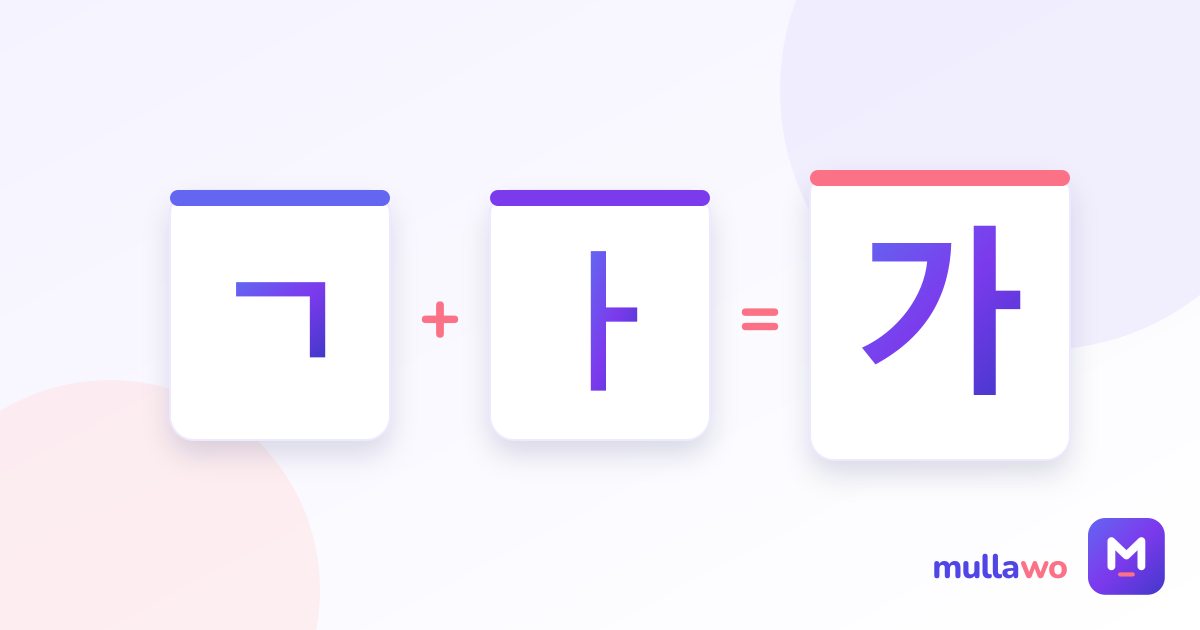
Korean has a reputation as a hard language, and in grammar and vocabulary that reputation is earned. The writing system is the exception. Hangul was designed — by a committee under King Sejong in the fifteenth century, on purpose, so that ordinary people could learn to read — and it shows. Most learners can read it slowly after one evening and comfortably after a week.
The trick is to stop seeing boxes and start seeing what is inside them.
The letters are a system, not a list
There are 24 basic letters: 14 consonants and 10 vowels. On top of those, Korean adds 5 tense consonants (doubled letters) and 11 compound vowels built from the basic ones. That is the full set of 40 that Mullawo's alphabet screen goes through, each with its name, its sound and an example word.
Forty sounds like a lot. It is less than it looks, because most of the set is derived from a few shapes.
Consonants draw the mouth. The basic consonants are pictures of where the sound is made:
- ㄱ g/k — the back of the tongue raised to the roof of the mouth
- ㄴ n — the tip of the tongue touching the ridge behind the teeth
- ㅁ m — the closed lips
- ㅅ s — a tooth
- ㅇ — the throat; silent at the start of a syllable, ng at the end
A stroke adds a breath. Add a line to a consonant and you get its aspirated partner: ㄱ → ㅋ (k), ㄷ → ㅌ (t), ㅂ → ㅍ (p), ㅈ → ㅊ (ch). Double it and you get the tense version: ㄲ, ㄸ, ㅃ, ㅆ, ㅉ — said with no breath and a tight throat.
Vowels are lines and ticks. Every vowel is a long line — vertical ㅣ or horizontal ㅡ — with short ticks attached. One tick is a plain vowel, two ticks add a y: ㅏ a, ㅑ ya; ㅗ o, ㅛ yo; ㅜ u, ㅠ yu. Compound vowels are two of these written together: ㅗ + ㅏ = ㅘ wa, ㅜ + ㅓ = ㅝ wo.
Once you see the pattern, you are not memorising forty shapes. You are memorising a dozen and the rules that make the rest.
Letters stack into syllables
The second idea is the box. Korean does not write letters in a row; it groups them into one block per syllable:
- consonant + vowel: 가 ga, 나 na, 고 go
- consonant + vowel + final consonant: 강 gang, 물 mul (water), 길 gil (way)
The vowel decides the layout. A vertical vowel (ㅏ, ㅣ) goes to the right of the consonant; a horizontal one (ㅗ, ㅜ, ㅡ) goes underneath. The final consonant — the batchim — always sits at the bottom.
And because every syllable has to start with a consonant, a syllable that begins with a vowel uses the silent ㅇ as a placeholder: 아이 ai (child) is ㅇ + ㅏ, ㅇ + ㅣ.
An order that works
First hour: the ten vowels. They are the most regular part of the system and you will need them in every block. Learn them as pairs — plain and y — and write each one a few times.
Second hour: the fourteen consonants, grouped by shape: the five "mouth pictures" above, then their stroked and doubled relatives. Say each one with a after it — ga, na, da, ra, ma — which is also how Korean children chant them.
Then: read blocks. Not words, blocks. Signs, menus, the names of K-pop groups, anything. Read slowly, letter by letter, and say the result. In the alphabet screen, tap a letter to see an example word in your own language — 길 way, 끝 end, 아이 child — and, where your phone has a Korean voice, to hear it.
Leave the compound vowels and the sound changes for the second week. Korean pronunciation changes letters at syllable boundaries in regular ways — 국물 is said gungmul, not gukmul. You do not need those rules to start reading; you need them to read well, and they make much more sense once the letters are automatic.
Then put the romanization away
Every Korean word in Mullawo carries a romanization in the official Revised Romanization system — 주황색 juhwangsaek (orange) — next to its IPA transcription. It is useful in the first days, while the letters are slow.
Then turn the transcription line off in Settings — it hides the romanization and the IPA together — and read the Hangul. Romanization is a crutch that never quite fits: eo and eu are two sounds English does not have, and seeing them in Latin letters keeps you guessing at an English pronunciation that is wrong. The whole point of an alphabet you can learn in a week is that you do not need anyone else's letters to read it.
A realistic first week
- Evening one: vowels and consonants, until you can sound out 가 나 다 라 마.
- Days two to seven: read every block you see; start cards in Korean with the romanization on.
- End of the week: transcription off.
By then Hangul is no longer the hard part. It was never meant to be.