
How many new words a day? Do the arithmetic before you choose
Twenty new words a day sounds modest. In a month it is a hundred cards a day, because every new word comes back. Here is the schedule Mullawo actually uses, worked out word by word, and how to pick a pace you can keep.
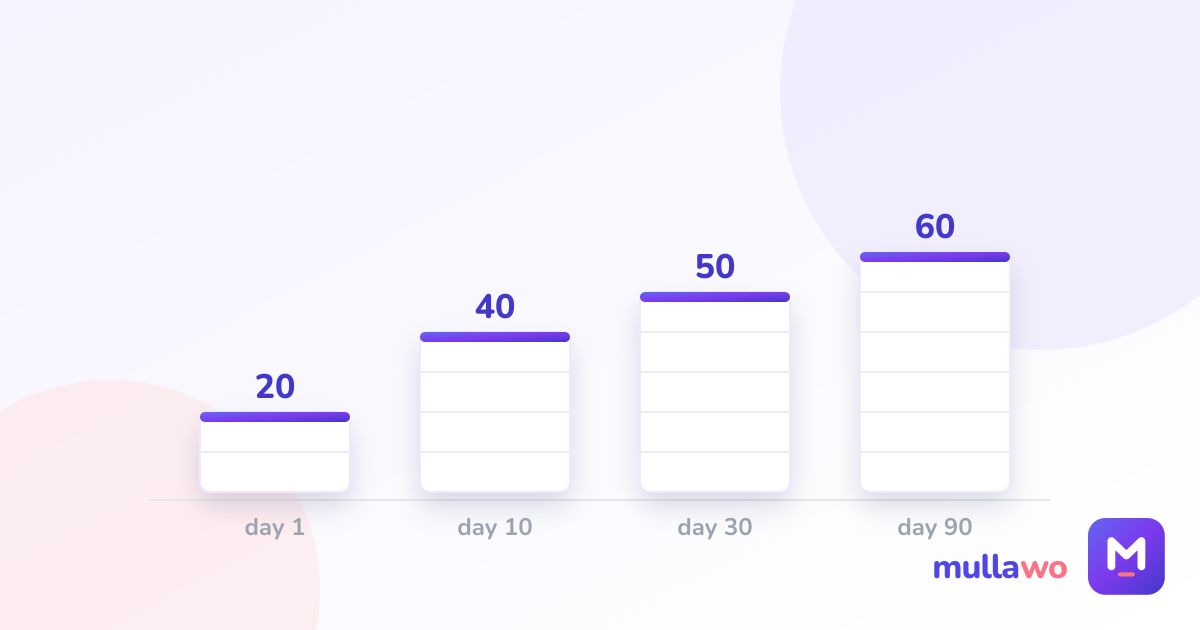
"How many new words should I learn a day?" is the most common question about vocabulary, and the usual answers — ten, twenty, fifty — skip the only part that matters. A new word is not one card. It is a card today, and again tonight, and again tomorrow, next week and next month. The real question is how many cards you can face every day, from now on, and that number is set by the pace you pick on day one.
So here is the arithmetic, using the schedule Mullawo actually runs.
The life of one word
Mullawo schedules every word with SM-2, the algorithm behind most spaced-repetition apps. Follow one word that you answer I know it every single time:
| Review | When it comes back |
|---|---|
| 1st — first time you see it | 7 hours later |
| 2nd | 1 day later |
| 3rd | 6 days later |
| 4th | about 17 days later |
| 5th | about 49 days later |
| 6th | about 5 months later |
After the first three steps the gap is multiplied by the word's ease — a number that starts at 2.5 and goes up by 0.1 with every clean answer — so the intervals grow fast. No gap is longer than a year.
By default Mullawo counts a word as learned once it has been answered right five times, is at least 21 days away, and has not become "hard" (an ease of 2.0 or more). For the perfect word above, that happens at the fifth review, about 24 days after you first saw it. Five views, three and a half weeks. (The three thresholds are under Settings → Study → Advanced, if you want a stricter or looser idea of "learned".)
That is the best case. A word you miss drops back to the seven-hour step and loses 0.8 of its ease; Almost keeps it moving but takes 0.14 off. Hard words therefore come back more often, which is the point — but it means every real number below is a floor, not an estimate.
What a daily pace really costs
Now add the same number of new words every day and count the cards that land on each day — perfect answers only:
| New words a day | Cards on day 10 | Day 30 | Day 90 onwards |
|---|---|---|---|
| 5 | 20 | 25 | 30 |
| 10 | 40 | 50 | 60 |
| 20 | 80 | 100 | 120 |
The pattern is simple: after the first month you are doing about five times your new-word pace every day, and about six times after three months — and that is if you never miss. With honest answers, some words take eight or ten views instead of five, and the load is higher still.
So "twenty a day" is a hundred-plus cards a day by the end of the first month. At five or six seconds a card that is around ten minutes, every day, without a break. Some people are happy with that. Many quit in week three and blame themselves.
What happens when you skip a day
Reviews do not disappear on a day off. They wait, and the next day you face two days' worth. Skip a week at twenty new words a day and you come back to several hundred cards — and a pile that size is how most vocabulary habits end.
This is the real argument for a modest pace: a pace you can keep on a bad day beats a pace you can only keep on a good one.
Choosing your pace in Mullawo
Mullawo does not have a separate "new words" dial. It has one number: words per session, 20 by default, anywhere from 5 to 300 in Settings. How many sessions you do a day, and how long they are, is your pace.
A practical way to use it:
- Starting out, or busy: one session of 20 a day. Your daily load settles into something you can do on the bus.
- Steady and motivated: two sessions a day, or a session of 40. If sessions start to feel like a chore by the third week, that is the table above arriving — slow down before you stop.
- Before a trip or an exam: push harder for two or three weeks, then drop back. The words you crammed stay on their own schedules; the load falls again within a month as their intervals stretch.
And on days when grading every card is too much, express mode lets you go through the cards without judging each one. It keeps the habit; the schedule simply learns less from that day.
The number to aim for
There is no magic number of new words. There is a magic property: you can do today's cards on your worst day of the week. If you can, your pace is right, whatever it is. If you cannot, slow down — not because you are failing, but because the arithmetic says the load only grows from here.
Ten new words a day is about 3,600 a year. That is the core vocabulary of most languages, at a load of around sixty cards a day. Few people need more speed than that. Almost everyone needs more consistency.