
When two cards look the same — sie, sein, groß and the labels that tell them apart
Languages do not cut meaning in the same places. One German word can answer three English ones, and a card that shows only that word cannot say which it means. Here is how Mullawo marks those cards, and what to do with the few no label can split.
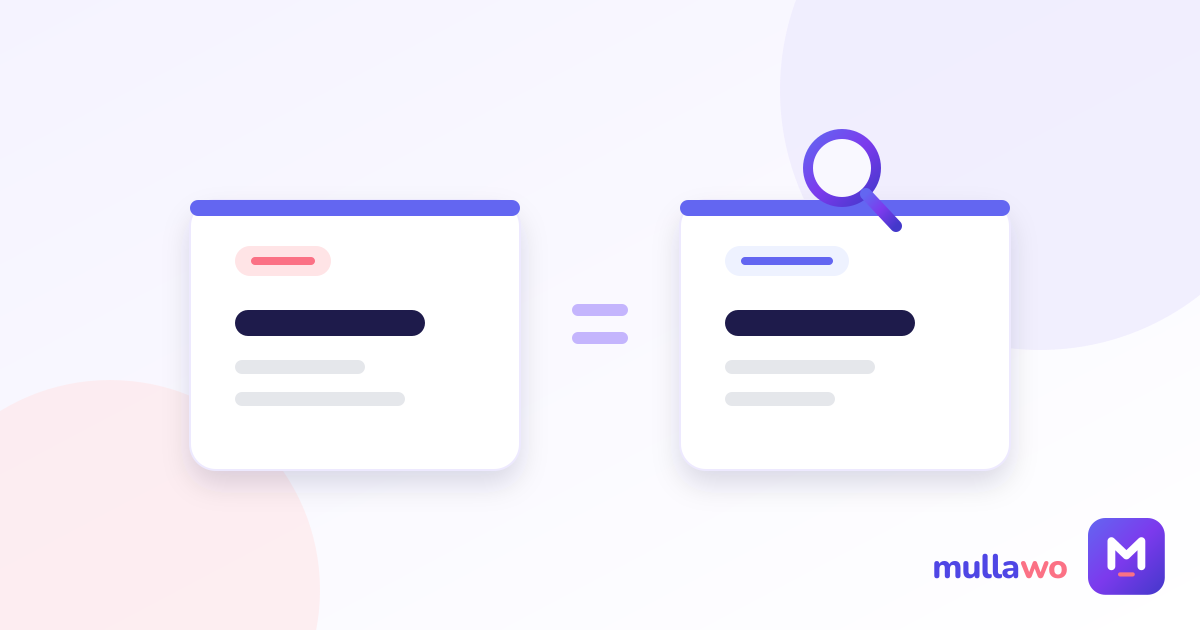
English has they, them and she. German has one word for all three: sie. English has be, his and its; German says sein for each. To and too are both zu. Absolute and absolutely are both absolut.
In a dictionary built from English, each of those is its own card — and should be: they are different words with different jobs. But turn the card round, so that German is the side you are asked, and three cards show exactly the same thing. You see sie. Which one is it? Whatever you answer, two times out of three the card says you were wrong.
This is not a mistake in the translation. Sie really is all three, and knowing that is part of knowing German. The problem is only the card: it cannot ask a question nobody can answer. So the cards that share a text carry a small label — and only those cards. Most of the deck shows none.
A part of speech, when that is the difference
Sein the verb and sein the possessive are not the same kind of word, and neither are absolut the adjective and absolut the adverb. When the text you are asked belongs to cards of different parts of speech, the top of the card names the part of speech of the one in front of you — a verb, a pronoun, an adjective, an adverb.
That settles zu as well: the card for to is marked as a preposition, the card for too as an adverb.
A grammar note, for pronouns
A part of speech does not help with sie: they, them and she are all pronouns. What separates them is grammar — case, number, gender. So beside the German word, next to its language code, the card adds a short note:
- they — nom., pl.
- them — acc., pl.
- she — nom., sg., fem.
The note is written in the language of your interface, not in German. A learner whose app is in Russian sees им. п., мн. ч., because a label you cannot read is no label at all.
These notes exist only where they are needed: for the pronouns that share a text with another card, in every language the app teaches — 281 cards in all.
A hint, when it is the sense that differs
Some cards differ neither in part of speech nor in grammar, but in meaning. For those the card carries a short hint on the question side, in your interface language — a few words that say which sense is meant. Too is marked excessively (too hot); great is marked large, eminent (Great Britain), which keeps it apart from the plain big and large.
The hint appears only when the text you are asked is shared with another card. If the question is unique, there is nothing to tell apart, and the card stays clean.
The pairs no label can split
A few pairs survive all three. German groß is big and it is large — same part of speech, same grammar, and no sense either side could reasonably be expected to know. The honest answer is that in German they are one word.
So when such a card asks groß and you answer large while the back says big, you have not failed: you knew the German. Mullawo trusts your grading — mark it I know it and move on. The schedule is there to measure what you know about the word you are learning, not to catch you on a distinction your language does not make.
Why there are fewer of these than there used to be
On 10 November we read the whole dictionary — all 4,629 cards in 31 languages — with one rule: every translation on a card carries one sense, in the dictionary form of its language. More than 17,000 translations, transcriptions and romanizations were corrected. A card that had drifted into two meanings across languages was brought back to one, which is what makes these labels possible: a hint can only name the sense if the card has a single sense to name.
If you meet a card that still looks like another and has no label, tap the warning icon on the card — Report Word. It comes to us, and it is exactly the kind of report that makes the next fix.