
How to learn Thai vocabulary as a beginner
Thai has its own script, five tones and no spaces between words — and almost no grammar in the way of a beginner. Here is how to build a first thousand words without getting stuck on the parts that scare people off.
Thai is the national language of Thailand, spoken by tens of millions of people, and it is not related to Chinese, Khmer or anything you are likely to have studied. Two things make it look hard from the outside: a script of its own, written without spaces between words, and tones that change what a word means. The good news is everything else. A Thai word does not change its form — no gender, no plural ending, no conjugation — so a word you have learned is a word you can use. For a beginner, that makes Thai a vocabulary language first.
Learn the script first, in pieces
Thai is written with 44 consonants, a set of vowel signs and four tone marks. Vowels are written around the consonant — before it, after it, above it or below it: กิน gin "to eat" has the vowel above, เกม geem "game" has it in front, ครู kruu "teacher" has it below. That sounds chaotic and is, in fact, a small closed set you can learn in a week or two.
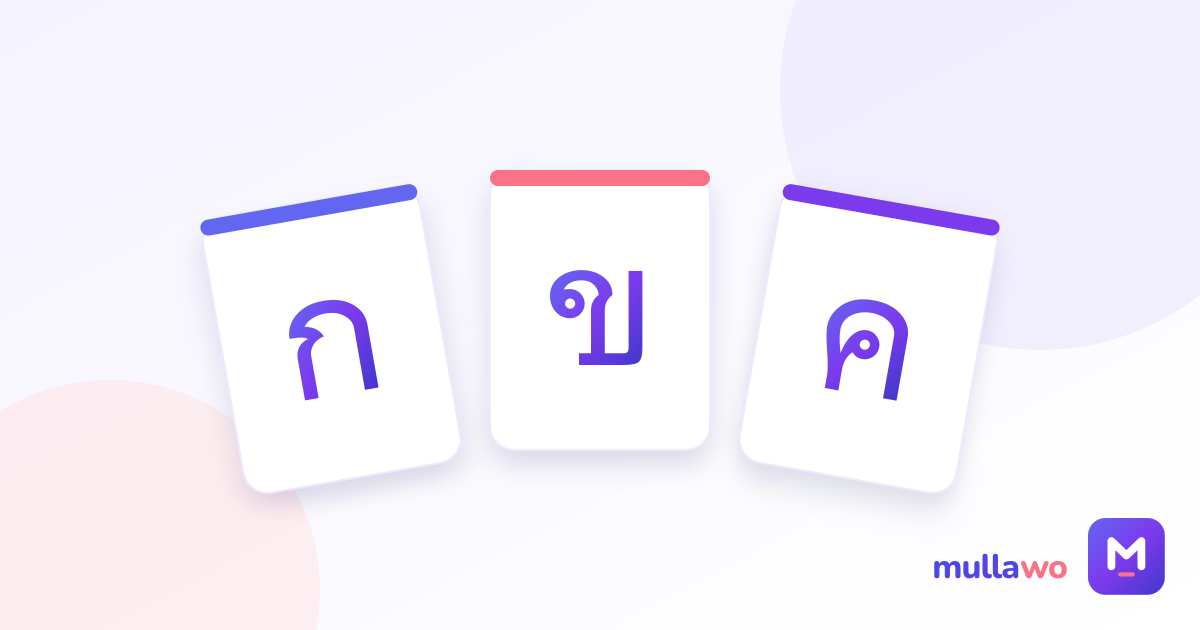
Do not try to learn all 44 consonants at once. Two are obsolete, and a good number of the rest turn up only in a handful of words borrowed from Sanskrit and Pali; start with the common ones. Learn each consonant with its name, the way Thai children do: ก ไก่ gɔɔ gài, "g as in gài, chicken", ข ไข่ kɔ̌ɔ kài, "k as in kài, egg". The name tells you the sound and gives you a first word for free.
Mullawo's Thai alphabet screen has all three parts: the 44 consonants with their names and their class, 26 vowels written on the carrier อ (อา, อิ, เอ …) so you see where each one sits, and the four tone marks. Every letter comes with an example word, read aloud by your phone's own Thai voice.
Tones: learn them with the word, not after it
Thai has five tones — mid, low, falling, high and rising — and they are part of the word, the way a vowel is. ม้า máa is "horse", หมา mǎa is "dog", มา maa is "to come". Same consonant, same vowel, three different words.
You will read that the tone of a written syllable follows from rules: the consonant's class (mid, high or low), the tone mark, whether the syllable ends in a vowel or a stop. Those rules are real, and the alphabet screen gives you the class of every consonant so you can start to see them. But do not wait until you have mastered the rules to start learning words. Learn each word with its tone from the first day — hear it, say it, read the tone in the romanization — and the rules will turn into something you recognise rather than something you calculate.
Words do not change — collect them
There are no articles and no grammatical gender. Plural is usually not marked at all: หนังสือ nǎng-sʉ̌ʉ is "book" or "books". Verbs do not conjugate; time is shown with separate little words or left to context. Every word you learn is the form you will see on a sign, hear in a shop and say yourself.
That makes Thai words cheap to collect. Start with the ones that carry the most meaning: food, home, family, numbers, getting around, the words on a menu.
Hear every word, then hear it again
Because tone is part of the word, a Thai word you have only read is a word you do not really know. Tap the speaker on every card and listen for the pitch as much as for the sounds. Thai also separates sounds that English does not — an unaspirated ป bp and an aspirated พ p, a short vowel and a long one — and you will not hear them unless you hear the word.
In Mullawo the Thai words are spoken by the Thai voice already on your phone, so the speaker works without our server.
A first thousand words, by frequency
The most useful trick in any language: learn words in the order people actually use them. The thousand most frequent words cover the majority of what you will hear in a day; the ten-thousandth is one you may never need.
Mullawo's dictionary is ranked by frequency, and 4629 of its words have a Thai translation, so the first cards you see are water, day, good, to go — not ornithology. Twenty new cards a day, five minutes, and in two months the first thousand are behind you. Spaced repetition decides which of them you need to see again and when; you only decide whether you knew the word.
Where the romanization helps and where it stops
Every Thai word in Mullawo carries two transcriptions: the IPA and a Paiboon romanization (หนังสือ → nǎng-sʉ̌ʉ). Paiboon was chosen because it writes the tone — máa, mǎa, maa — while the official Royal Institute system does not, and spells all three of those words ma.
Use the romanization in the first weeks, while the script settles and your ear learns the tones. Then let your eyes move to the Thai itself. The romanization is a crutch: Thai signs, menus and messages do not come with one, and the sooner the script reads by itself, the sooner Thailand stops looking like a wall of letters.
A realistic first month
- Week 1–2: the common consonants with their names, the vowels on อ, the four tone marks.
- From day 1: twenty cards a day, nouns first, speaker on every card, tone read from the romanization.
- Do not open a grammar book yet — there is very little in it you need this month.
By day thirty you will sound out Thai on a sign, recognise several hundred words with their tones, and have the words the rest of the language is built from. That is the month that decides whether a person keeps going — and it is a month of vocabulary, not grammar.